Written by Engr. Ahmed Rajput, Lead Inspector, StructSure Pakistan (PEC-registered civil engineer, MIEAust), and Engr. Barkat Ali Rajput, Chairman, StructSure Pakistan (civil engineer with 50+ years of construction experience).
Quick answer: When building a house in Pakistan, make sure your contractor does these 10 things: compact the soil and pass a Field Density Test (FDT), install a damp proof course (DPC), waterproof the basement, waterproof bathrooms and wet areas with a ponding test, fix mesh at RCC and masonry joints, use concrete cover blocks, vibrate and cure concrete properly, waterproof and drain the roof, apply anti-termite treatment at foundation stage, and lay tiles with full adhesive coverage. Most of these are hidden once the house is finished, so they must be checked during construction.
As Pakistan’s first international home inspection company, StructSure has completed 185+ building inspections in Karachi and 300+ in Australia. Our engineers keep seeing the same pattern. Some houses only 5 to 10 years old are in worse condition than houses 50 years old. Others, 20 to 25 years old, are still excellent.
The difference is rarely the marble, the elevation or the imported tiles. Although, It is construction quality, and the small details contractors often skip. Here is what to insist on, stage by stage. If you want an engineer to check these for you, see our independent construction-stage inspections.

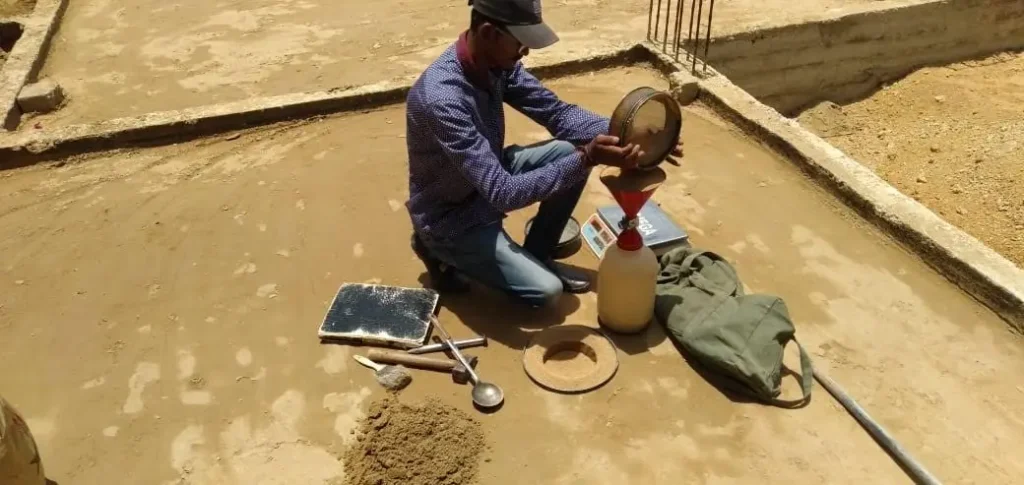
1. Soil compaction and Field Density Test (FDT)
Backfill under the plinth and floors must be compacted in layers, not dumped in one go. Ask for a Field Density Test (FDT) on each layer and do not move to the next stage until it passes.
Why it matters: poorly compacted fill settles over time. That causes sunken floors, gaps under skirting and cracks in floor tiles and walls.
2. Damp proof course (DPC)

Rising damp is one of the most common problems we find in Karachi homes, helped by the coastal climate and high groundwater in many areas. A proper DPC at plinth level stops ground moisture travelling up the walls.
Why it matters: a missing or broken DPC leads to damp walls, salt marks, blown plaster and peeling paint that no amount of repainting fixes.
3. Basement waterproofing
If your house has a basement, the outside face of the retaining walls needs a properly designed waterproofing system. That means a suitable bituminous membrane or coating, with a protection layer and drainage detailing.
Why it matters: basement waterproofing is easy during construction and very expensive afterwards, because the outside face is buried.
4. Bathroom and wet area waterproofing
A simple cement slurry or “pedlo” coat is not proper waterproofing. Use a suitable cementitious system such as AQUAFIN or Sika, covering the floor, the wall-floor corners, pipe penetrations and the required wall height.
Before tiling, insist on a ponding test: the floor is flooded and left for 24 to 48 hours to confirm there is no leak below. For finished homes, our leakage and seepage check and plumbing pressure test trace problems without breaking tiles first.
Why it matters: bathroom leaks are the most common cause of seepage into rooms and ceilings below, and fixing one means breaking finished tiles.

5. Mesh at RCC and masonry joints
Where concrete columns and beams meet block masonry, the two materials move differently. Fix galvanized wire mesh or approved joint reinforcement across these junctions before plastering.
Why it matters: without mesh, you get straight-line plaster cracks along columns and beams within the first few years.

Building in Karachi right now? WhatsApp “BUILD” to 0320 202 4444 and our engineers will tell you which checks are due at your stage.
6. Concrete cover blocks and spacers
Steel reinforcement must sit at the cover depth shown on the structural drawings for that exposure condition. Approved cover blocks and spacers keep it there while concrete is poured. A structural check with a rebar scanner can confirm cover after the pour.
Why it matters: steel too close to the surface corrodes, expands and cracks the concrete off. This is a leading cause of spalling slabs and columns in Karachi’s salty air.
7. Concrete vibration and curing
A needle vibrator must be used during every pour to remove air and fill around the steel. After the pour, concrete needs proper curing, kept continuously wet, for the period your engineer specifies. Our grey structure inspection tests concrete quality before finishes hide it.
Why it matters: unvibrated concrete leaves honeycombing and voids. Poorly cured concrete never reaches its design strength. Good concrete comes from placing, vibration and curing, not just the mix.

8. Roof waterproofing and drainage
Karachi’s heat and monsoon rain are hard on roofs. Make sure the roof has a proper slope to drainage outlets, plus a suitable waterproofing system such as a membrane or canvas-reinforced treatment, correctly specified and installed.
Why it matters: waterproofing without drainage fails. Ponding water finds every weak point.
9. Anti-termite treatment
We find termite damage in many Karachi homes, in door frames, cupboards and wooden flooring. Professional anti-termite treatment should be applied to the soil at foundation stage. Where suitable, a chemical reticulation piping system can be installed for easy re-treatment later.
Why it matters: prevention at construction stage costs a fraction of replacing damaged woodwork.
10. Tile installation and drummy tiles
“Drummy” tiles sound hollow when tapped because they are not fully bonded. Insist on proper surface preparation, the correct adhesive or mortar bed, and full coverage under each tile. A tile vibrator or suitable bedding tools help, depending on the tile system.
Why it matters: hollow tiles crack and debond after a few years, especially large-format floor tiles.
The real quality of a house is what you cannot see
Once plaster, paint and tiles go on, almost everything on this list is hidden. That is exactly why it gets skipped.
Building a home takes your life savings. Do not leave its quality to trust alone. An independent engineer can check these details at the right stage, before they are covered up. Already built? A contractor work audit shows what was done and what was missed. Always build to plans approved by the Sindh Building Control Authority.
How do you know your contractor is doing all this?
StructSure Pakistan, Pakistan’s first international home and building inspection company, provides independent engineering inspections for homes under construction in Karachi. Whether your house is at foundation stage, grey structure or close to handover, our PEC-registered engineers check the critical details before they are covered up.
We check workmanship, visible structural condition and the relevant tests and records, using around PKR 7 million of non-destructive testing equipment: UPV, rebar scanners, digital Schmidt hammers, thermal cameras and hydrostatic pressure testing. Every report is delivered within 48 hours.
We work only for you. StructSure does no construction or renovation work, so our findings are never influenced by a contractor.
Also Read: The Triple Water Trap: What an 8-Year-Old Karachi House Taught Us About Hidden Water Damage