Key takeaways
- In this pre purchase inspection, water was the common thread behind most defects: no visible roof membrane, no identifiable damp-proof course and failing bathroom grout.
- The most urgent issue was hollow concrete under the first-floor ceilings — a falling hazard caused when water rusts the steel inside the slab.
- Cracked beams and doubtful UPV readings should be checked by an engineer before you pay token money, not after.
- Most of the damage was typical of an older Karachi house that was never properly waterproofed — and has well-known repairs.
- Repairs of this kind can run into tens of lakhs of rupees. Knowing this before you buy is what an inspection is for.
Every week, families in Karachi buy houses after a quick walk-through, a fresh coat of paint and the seller’s word. At StructSure Pakistan’s first home and building inspection company — we see what the paint hides. This article walks through a real premium pre-purchase inspection we carried out in October 2026 on a 16-year-old, ground-plus-one bungalow in a coastal part of Karachi. Client and property details are kept confidential; the findings and the engineering are real.
What we inspected and how?
This was a premium pre-purchase inspection, led by two PEC-registered civil engineers with an NDT technician, a plumbing specialist, an electrical specialist, a site inspector and a documentation lead. The house was occupied and heavily furnished, which limited access to a few rooms — a common reality in Karachi resale inspections, and one we record openly in every report.
| Test | What it checks |
|---|---|
| Visual inspection | Roof, both floors, exterior, bathrooms, kitchen, tanks and drainage |
| Ultrasonic pulse velocity (UPV) | Concrete quality at sampled columns, beams and slabs |
| Rebar scanner | Depth of steel bars below the surface |
| Moisture meter + tap test | Damp walls, hollow plaster and hollow concrete |
| Hydrostatic pressure test | Hidden leaks in the water pipes |
| Electrical checks | Distribution boards, wiring, sockets |
What we found: water, water, water
The report listed 27 findings. Five were safety items, most were major defects, and a handful were maintenance issues. But read together, they told one story: water had been getting into this house for years.
- Roof: no waterproofing membrane was visible, the roof surface and parapets were cracked, and the skylight was not sealed.
- First-floor ceilings: hollow, loose concrete cover across the whole floor.
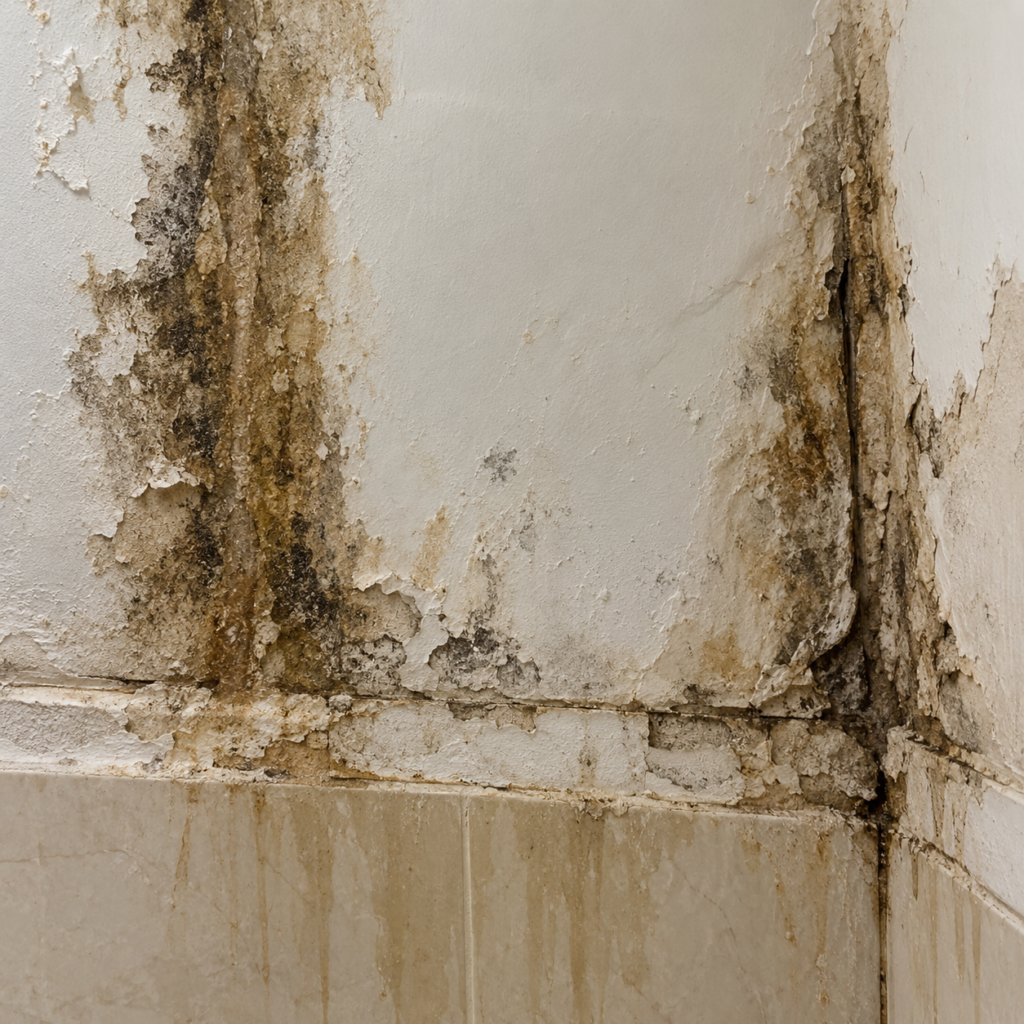
- Ground floor: damp at the base of walls throughout, rotten wooden skirting and a damaged wooden floor; no damp-proof course could be identified.
- Bathrooms: failed grout and gaps around fittings letting water into walls and the rooms below.
- Plumbing: the pressure test dropped sharply within 15 minutes — consistent with an active leak.
- Exterior: cracks where block walls sit on chajjas and cantilevers, and a separation crack between the roof slab and parapet all round.
- Electrical: an exposed live wire at a socket, taped joints and an untidy distribution board.

Why does ceiling concrete become hollow and fall?
In this house the hollow areas covered the living room, bedrooms, a bathroom ceiling and the kitchenette. Our UPV readings across those ceilings were very low and irregular, because the sound pulse could not cross the gap between the loose layer and the slab. The first job is safety: keep people from sitting or sleeping under these areas and have loose pieces removed under supervision. The permanent fix only works after the roof is waterproofed.
Important: hollow ceiling concrete is a falling-material hazard. It does not, on its own, mean the slab is about to collapse but how much steel has been lost can only be confirmed once the cover is opened up by an engineer.
Is a cracked beam dangerous?
Short answer: treat any beam crack wider than a few millimetres as potentially structural until a structural engineer has assessed it. For a house you are buying, do this before you commit.
We found a beam at the roof-stair opening with cracks estimated at over 5 mm, another at about 5 mm, and a skylight beam with exposed, rusted steel. Possible causes include long-term water entry, shrinkage or load. We deliberately did not prescribe a repair method: the right repair depends on the cause, and that needs opening up. Read more about our Structural Express Check.
What does a UPV test actually tell you?
Short answer: UPV measures how fast sound travels through concrete at the tested point. It is an excellent screening tool, but it does not give concrete strength by itself and it does not certify a building as safe.
Of the valid readings, about half were satisfactory, several were borderline and one column was low. A few readings were so low they did not describe the concrete at all — they were taken across hollow ceiling cover, an open crack and damp beams. We listed those separately so the client could see them, rather than hiding them or letting them distort the overall picture. Interpretation followed the widely used ACI and IS 13311 guidance on pulse velocity, applied as a comparative indicator.
What is a damp-proof course and does your house have one?
Short answer: a DPC is a water-resisting layer at the bottom of walls that stops ground moisture rising. Tide marks, peeling paint and rotting skirting along ground-floor walls are classic warning signs.
But be careful: leaking pipes, bathroom seepage and planter beds against walls produce the same symptoms. In this house all three were present. That is why our plan says fix the leaks first, re-measure moisture, then treat rising damp not the other way round.
Coastal Karachi needs coastal-grade repairs
Houses near the sea face salt-laden air and salty, wet ground. Two items in this inspection need special attention in coastal areas such as DHA and Clifton:
Chajjas, cantilevers and slab-to-masonry joints
Block walls sitting on chajjas and cantilevered terraces had cracked, and there was no evident mesh where the slab meets the first-floor block masonry. The fix: machine-cut the affected areas, remove weak concrete, plaster and blocks, apply a bonding adhesive suitable for coastal conditions, repair with high-strength coastal-grade mortar, fix galvanised BRC mesh across every concrete–masonry joint, then seal and recoat.
Plinth beam protection
Planters and wet soil were placed directly against the house beside the garage side, keeping the plinth beam permanently wet. The fix: move the planting about 2 ft (600 mm) away from the structure, coat the exposed plinth beam with bitumen — including the underside where you can excavate — and protect its face with stone or another coastal-suitable facade, with the ground sloping away from the wall.
The six rectification plans
Every StructSure report ends with engineer-written rectification plans, so the buyer knows not just what is wrong but how to fix it and in what order. These are the six we issued for this house:
RP-01Roof waterproofing & crack repair
Clean the roof, open and fill all cracks, seal the skylight and solar-structure legs, correct falls to drains, then a primer plus a proper membrane (torch-on bitumen or reinforced liquid membrane — not paint). Close with a 48-hour ponding test.
RP-02Ceiling concrete (spalling) repair
Seal the roof first, prop and mark hollow areas, break out loose concrete, clean steel to bright metal, apply anti-corrosion primer and bonding agent, rebuild with polymer-modified repair mortar. Where steel loss is found, the repair is designed by a structural engineer.
RP-03Damp-proof course & plinth protection
Fix leaks, move planters away, protect the plinth beam, remove damp plaster to about 1 m, inject DPC cream at the wall base, re-plaster with salt-resistant renovating plaster and finish with breathable paint.
RP-04Bathroom waterproofing & grout
Option A: rake out and epoxy re-grout, seal fittings and corners, replace broken tiles. Option B: remove tiles, install a liquid membrane with corner tape, 24-hour flood test, re-tile with epoxy grout.
RP-05Crack repair with BRC mesh
For non-structural junction cracks only: cut out, fill with flexible filler, fix galvanised mesh across the joint, re-plaster and repaint. Wide cracks are monitored first; structural beam cracks are excluded and follow the engineer’s design.
RP-06Coastal elevation restoration
Repair render and cracks with coastal-grade materials, then a breathable, weather-resistant exterior coating system with optional stone or porcelain accents for a low-maintenance finish.
The right order of repairs
- Investigate first. Engineer opening-up of cracked beams and doubtful elements; trace the plumbing leak.
- Waterproof the roof. Nothing below stays repaired while water still comes in from the top.
- Repair ceilings and beams. Only once the roof is sealed.
- Fix plumbing and bathrooms. Then re-measure moisture.
- Protect the base of the house. Plinth beam, planters and, if confirmed, DPC injection.
- Cracks, elevation and finishes last. Mesh, coastal-grade mortar, coating, then paint and timber.
How much do repairs like these cost?
For a large bungalow with this combination of problems, a rough repair budget can easily run into tens of lakhs of rupees before electrical, plumbing, tanks and termite treatment are added. That is many times the cost of the inspection itself. In this case we gave the buyer a rough Karachi-rate estimate for each plan, clearly labelled as a planning guide for negotiation and not a quotation, because no quantities were measured on the day.
Should you still buy a house with water damage?
Short answer: often yes — if the problems are mainly waterproofing-related, the structural items check out, and the price reflects the repairs.
We told this buyer plainly: most of what we found is typical of a house of this age in Karachi that was never properly waterproofed, and it has well-known repairs. A few items are not routine and decide whether the price is right. Our recommended way forward:
- Investigate — engineer opening-up check before any token money.
- Price — get written contractor quotations and agree the repair budget.
- Decide — proceed with a planned repair programme if the check is satisfactory; renegotiate or reconsider if it is not.
- Make safe — ceilings, electrics, roof stair and termite treatment before moving in.
- Repair in order — and book a reinspection to close each item.
Documents to ask the seller for
- Approved and as-built architectural and structural drawings
- Soil investigation report
- Completion certificate from the relevant authority (for DHA properties, see DHA Karachi)
- Records of past repairs, waterproofing and termite treatment
In this case none were presented — which is common, and exactly why an independent inspection matters. Always check that your engineer is registered with the Pakistan Engineering Council.
Also Read: 7 Warning Signs of your house It Needs Attention Before It’s Too Late